



287(g) in Oklahoma: How Local Police Become Immigration Enforcers
In January of this year, Yingchao Fan experienced many of our worst nightmares. While driving through a snowstorm on Interstate 40, he was involved in a rollover car accident.[i] Needing emergency assistance, Mr. Fan dialed 911. Officers from the Oklahoma Highway Patrol were first on the scene. Within a few hours, Mr. Fan was transported straight from the side of the highway to the Sequoyah County Jail. He was not charged with any crime relating to the car accident. Instead, Oklahoma Highway Patrol officers held him on suspicion of being in the United States without lawful status.
To be clear, Mr. Fan did exactly what proponents of immigration enforcement say he was supposed to do: he immigrated the “right way.” He has a legal work permit and a pending asylum claim. He had notified the Department of Homeland Security of his presence in the United States and was awaiting his day in court. And he explained all of this to the Oklahoma Highway Patrol, who were there only because Mr. Fan had alerted them to the situation. But none of this prevented his arrest or detention. Due to a cooperative agreement between the Oklahoma Highway Patrol and the Department of Homeland Security, Mr. Fan was arrested, held on an immigration detainer, and placed in ICE custody.
Unfortunately, Mr. Fan’s experience is not unique. As of January 2026, Oklahoma ranked fifth in the country in immigration apprehensions per capita.[ii] This surge in arrests is primarily due to the dozens of Oklahoma law enforcement agencies that have signed cooperative agreements with ICE over the last year.[iii] As a result, local police officers have shifted their focus away from promoting public safety within their communities and towards fulfilling the federal government’s goal of deporting more than fifteen million people by 2029.[iv] None of this would have been possible without the 287(g) program.
What is the 287(g) program?
The 287(g) program was created by the Illegal Immigration Reform and Immigration Responsibility Act of 1996.[v] Participation in the program is completely voluntary, meaning local officials choose whether they wish to enter into a cooperative agreement with ICE. Once the department has agreed to participate, state and county police officers are deputized to carry out select immigration enforcement activities.[vi] The scope of the agency’s involvement depends on the model of agreement it chooses. Agencies have three options:
- the Jail Enforcement Model requires agencies to hold bed spaces open within their jails specifically for immigration detainees.[vii] Thereafter, the agency will transfer the detainee to ICE-approved detention centers.
- the Warrant Service Officer Model gives officers the power to assist in and execute arrest warrants for immigration violations on individuals scheduled for release from criminal custody.[viii]
- the Task Force Model empowers officers to conduct immigration enforcement during traffic stops and other street-level enforcement.[ix] It effectively converts local law enforcement officers into hybrid agents – part regular police officer, part ICE official.
What is the landscape of 287(g) in Oklahoma?
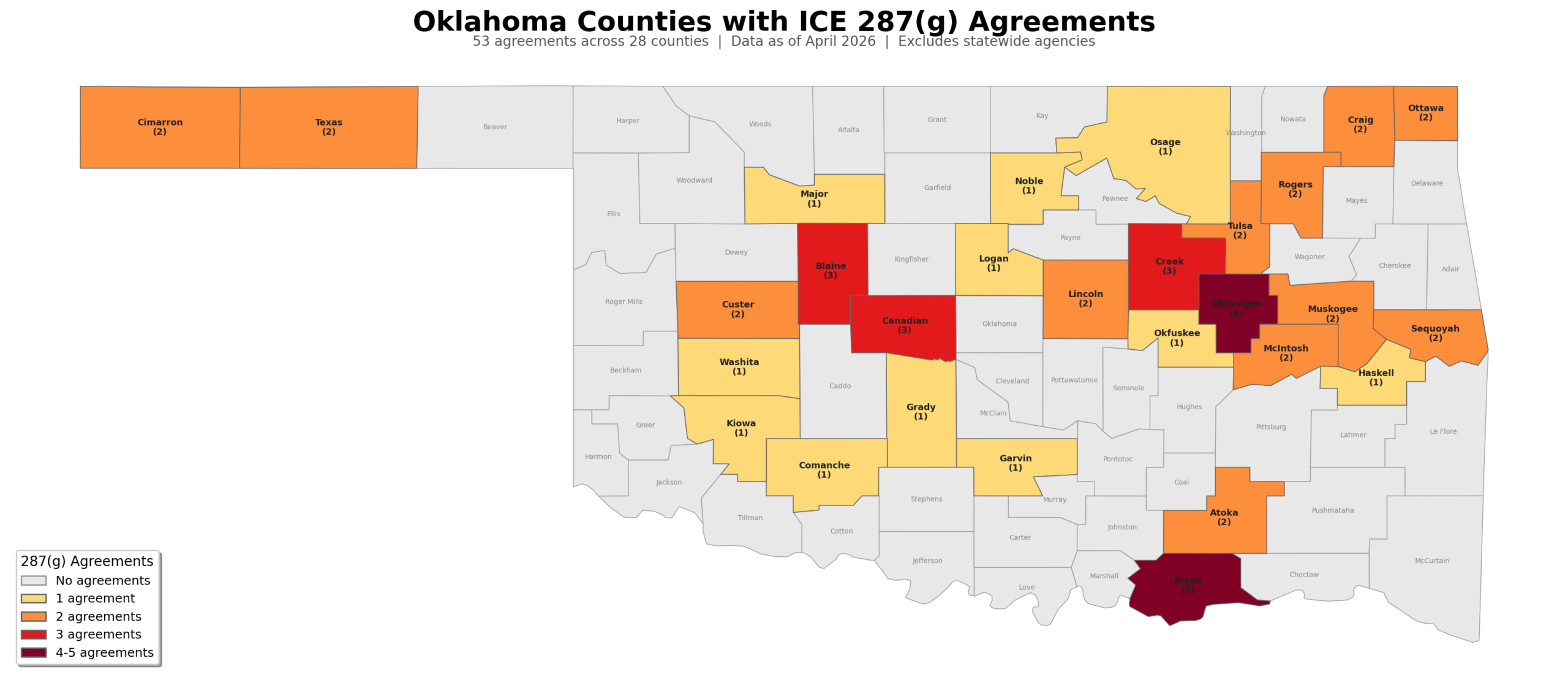
As of April 2026, over thirty Oklahoma police departments or agencies have agreed to cooperate with ICE.[x] The Oklahoma Highway Patrol is especially involved: as of November of 2025, around 750 OHP officers—most of their force—are deputized under the Task Force Model.[xi] OHP officers use checkpoints and regular traffic stops to question people about their immigration status. No longer do our noncitizen neighbors feel safe on the road. A simple traffic stop can change their lives in an instant.
What harm is caused by the 287(g) program?
The 287(g) program has devastated our communities. While there are many issues with the program, three main trends are cause for concern about its continued growth:
- First, the 287(g) program erodes trust in local law enforcement.[xii] Successful police investigations require officers to build a rapport with victims. But when noncitizen victims fear that any interactions with law enforcement may lead to their deportation, they opt not to report crimes. An expansive 287(g) program means that hundreds of crimes are currently going unreported and unresolved.
- Second, the 287(g) program is an incredible waste of taxpayer money.[xiii] While ICE promises to reimburse certain costs related to the 287(g) program, by and large, local taxpayers foot the bill.Implementing and maintaining these programs diverts thousands of dollars away from regular law enforcement, and these costs are passed onto community members through higher property taxes. The program has also proven costly through massive payouts in successful lawsuits. In Maricopa County, Arizona, for example, litigation over the 287(g) program resulted in over $300 million in settlements. As with the expenses noted above, the cost of lawsuits against local and state police is borne most by local taxpayers.[xiv]
- Third and most importantly, the 287(g) program leads to racialized policing.[xv] When officers are incentivized to stop and question suspected noncitizens, people of color tend to be detained and questioned at disproportionate rates.[xvi] In 2022, the ACLU released a report called License to Abuse: How ICE’s 287(g) Program Empowers Racist Sheriffs and Civil Rights Violations. The report found that nearly 60% of sheriffs involved had a history of anti-immigrant and xenophobic statements. Moreover, at least 65% of agencies working with ICE showed patterns of racial profiling and other civil rights violations. The 287(g) program accelerates racialized policing, and it does so on the taxpayer’s dime.
What can communities do to fight back against the expansion of 287(g)?
If you wish to fight against the expansion of the 287(g) program, consider taking the following steps:
First, identify whether you live in a jurisdiction covered by the 287(g) program. The Department of Homeland Security maintains a list of active agreements on its website.[xvii] Once you’ve confirmed that your local police department is involved in the program, scroll to the bottom of the agreement and identify the name of the official who signed it.
Second, decide on a plan of action. This usually requires creating a dialogue between the community and law enforcement leaders, as well as your local elected officials. Consider drafting a community letter or submitting an Op-Ed to your newspaper. Try to get this topic on the agenda of a city council meeting and email your representatives to set up a time to discuss it. Organize town halls to raise awareness.
Third, connect with local community members. Ask your neighbors and community members whether they’d be willing to join a community letter or attend a city council meeting with you.
Fourth, research and develop your talking points. Center your message around certain core values, such as:
- Community safety and protection;
- Trust between communities and government/law enforcement; and
- Civil rights, racial justice, and human dignity
Fifth, research and develop your proposed solutions. While the ultimate goal should be terminating the 287(g) agreement, there are other options short of that objective that may be more politically feasible. Whether through a community letter or at a city/council meeting,
Encourage the local official who executed the 287(g) agreement to:
- Explain how they plan to balance and allocate officers’ time between immigration enforcement and investigating actual crime;
- Limit the number of officers deputized under the 287(g) program;
- Abandon the Task Force Model for a less invasive model; and/or
- Commit to performance measures and ongoing reporting based on regular audits to ensure officers are not committing civil rights violations.
Consider asking your county or city council to:
- Conduct financial cost and liability assessments on the program;
- Impose a requirement that law enforcement officials provide periodic updates of the amount of money spent and the number of arrests resulting from participation in 287(g);
- Create a community-based oversight group or other forum designed to document civil rights abuses experienced by people who are arrested pursuant to 287(g); and/or
- Schedule a public hearing where community members can air their concerns about 287(g) participation.
[i] https://www.oklahoman.com/story/news/state/2026/02/12/ice-immigration-policy-oklahoma-man-called-911-arrested/88623535007/.
[ii] https://www.oklahoman.com/story/opinion/2026/01/21/ice-in-oklahoma-deportations-skyrockted-in-2025/88268623007/.
[iii] https://oklahomawatch.org/2026/02/17/more-than-30-oklahoma-agencies-sign-immigration-enforcement-agreements/; https://themarkup.org/tools/2025/04/16/law-enforcement-ice-cooperation-tracker.
[iv] https://www.cnn.com/2024/05/01/politics/trump-immigration-what-matters#:~:text=Donald%20Trump%20explains%20his%20militaristic,20%20million%20people%20%7C%20CNN%20Politics.
[v] https://www.americanimmigrationcouncil.org/fact-sheet/287g-program-immigration/.
[vi] https://www.americanimmigrationcouncil.org/fact-sheet/287g-program-immigration/.
[vii] https://www.americanimmigrationcouncil.org/fact-sheet/287g-program-immigration/.
[viii] https://www.americanimmigrationcouncil.org/fact-sheet/287g-program-immigration/.
[ix] https://www.americanimmigrationcouncil.org/fact-sheet/287g-program-immigration/.
[x] https://themarkup.org/tools/2025/04/16/law-enforcement-ice-cooperation-tracker.
[xi] https://www.news9.com/oklahoma-city-news/oklahoma-operation-guardian-troopers-ice-authority.
[xii] https://www.americanprogress.org/article/287g-agreements-harm-public-safety/.
[xiii] https://www.americanprogress.org/article/287g-agreements-harm-public-safety/;https://www.lawfaremedia.org/article/the-return-of-287(g)--how-trump-s-immigration-plan-may-leave-sheriffs-liable.
[xiv] https://www.cbsnews.com/news/police-misconduct-lawsuits-settlements-taxpayers/.
[xv] https://www.aclu.org/publications/license-abuse-how-ices-287g-program-empowers-racist-sheriffs.
[xvi] https://www.americanimmigrationcouncil.org/fact-sheet/287g-program-immigration/.
[xvii] Ihttps://www.ice.gov/identify-and-arrest/287g; https://themarkup.org/tools/2025/04/16/law-enforcement-ice-cooperation-tracker.