
News & Commentary
Latest Event
NextGen Meeting: Find your voice. Create change.
The goal of this program is to provide students with a place to meet other young advocates, connect with community leaders, and learn new skills and information that will allow them to be better advocates in their schools and communities.
The purpose of this first meeting is for students to get to know each other and meet community organizing leaders in OKC. Students will also have a chance to brainstorm ideas on how to approach pressing issues in their communities.


4 Quotes from Gavin Grimm’s Latest Victory
The Fourth Circuit Court of Appeals yesterday ruled in favor of American Civil Liberties Union client Gavin Grimm, deciding that restroom policies segregating transgender students from their peers and denying transgender student accurate transcripts are unconstitutional and violate Title IX, the federal law prohibiting sex discrimination in education. The decision comes after a five-year long court battle that began when the American Civil Liberties Union and ACLU of Virginia filed a sex discrimination lawsuit against the Gloucester Country School Board for adopting a discriminatory policy requiring Grimm and other transgender students to use “alternative private” restrooms. Here are four highlights from the decision today:

Hundreds of Thousands of People in Limbo as They Wait for Justice
Manar Waheed, Senior Legislative and Advocacy Counsel, ACLU
What’s it Like to be in Immigration Lockup During a Pandemic?
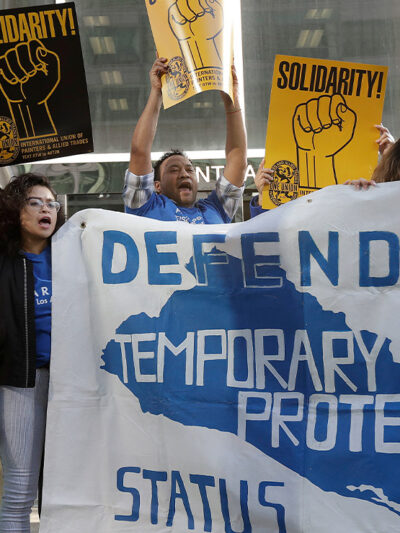
In the 1980s, fewer than 2,000 people were locked up in an immigration detention facility on an average day in America. Since then, that number has skyrocketed, quadrupling from 7,475 to 32,985 people detained by ICE per day between 1995 and 2016. Under the administration of President Donald Trump, the numbers have shot up even higher — at one point last year, a staggering 56,000 people were behind bars each night in an ICE detention facility. When asylum-seekers and other migrants in Customs and Border Protection facilities are included, the total figure rises to nearly 80,000 people detained by the U.S. government per day.This explosive growth of the U.S. immigration detention system tracks the rise of mass incarceration in America, prompted by punitive legislation passed by Congress in the mid-1990s around the same time as the infamous “crime bill,” and later through a massive post-9/11 expansion. Since then, the number of detained immigrants in the U.S. has grown nearly every year under Democratic and Republican administrations alike. Now, it’s a sprawling prison system, with 40 new immigration detention centers opening their doors just since the beginning of the Trump presidency alone. For immigrants caught in this system, life is often a nightmare of rampant medical neglect, overuse of solitary confinement, sexual abuse, excessive use of force, arbitrary transfers to other facilities across the country, unreasonably high bond costs, and long periods spent away from family members and loved ones. The COVID-19 crisis pulled the curtain back once again on the abuse and neglect that is deeply embedded in these detention facilities. While the rest of the country hunkered down in their homes, immigrants in detention have been forced to confront the pandemic in cramped conditions without adequate cleaning protocols or in some cases even basic sanitation supplies like soap. Guards have violently retaliated against immigrants protesting those conditions, and ICE has resisted efforts to secure their release for public health reasons.A combination of lawsuits and public pressure eventually forced ICE to release more than 1,000 people from detention because of concerns over the spread of COVID-19 between mid-March and early May. Legal actions brought by the ACLU have secured the release of more than 450 people so far. But there are still more than 21,000 people in immigration detention — a drop since last year’s high that is largely attributable to a near-total shutdown of the southern border. Whenever a new administration takes office, it will inherit an immigration detention system that has become an out-of-control, wasteful, and cruel behemoth. Drastically reducing the number of people trapped inside that system will be a crucial first step towards establishing a more humane and responsible immigration policy. In recent weeks, the ACLU interviewed a number of immigrants who were released from detention due to concerns over the COVID-19 crisis. They shared the following stories of what it was like to be incarcerated in an immigration detention facility during the pandemic. *Note: interviews have been condensed and edited.


The Democratic Platform Heads in Right Direction on Criminal Justice, but Still Misses the Moment
Udi Ofer, Former Director, Justice Division, ACLU National Political and Advocacy Department
As D


An Abortion Advocacy Movement for Everybody
Blair Wallace, she/her/hers, Policy and Advocacy Strategist, ACLU of Texas
Abor

We’ve Filed 400 Legal Actions Against Trump
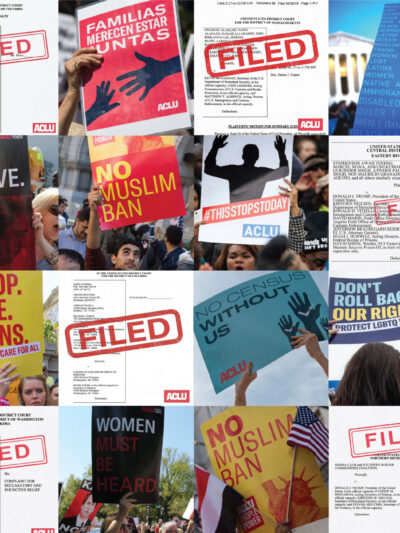
Immediately after Trump’s election, we put the president and his administration on notice: If they enacted unconstitutional and illegal policies, we would see them in court. We meant it. As of today, we’ve filed 400 legal actions against this administration. Our 400th filing was a class-action lawsuit that seeks to block the removal of children seeking asylum at the border.

Stay Informed
Sign up to be the first to hear about how to take action.
By completing this form, I agree to receive occasional emails per the terms of the ACLU’s privacy statement.
By completing this form, I agree to receive occasional emails per the terms of the ACLU’s privacy statement.